
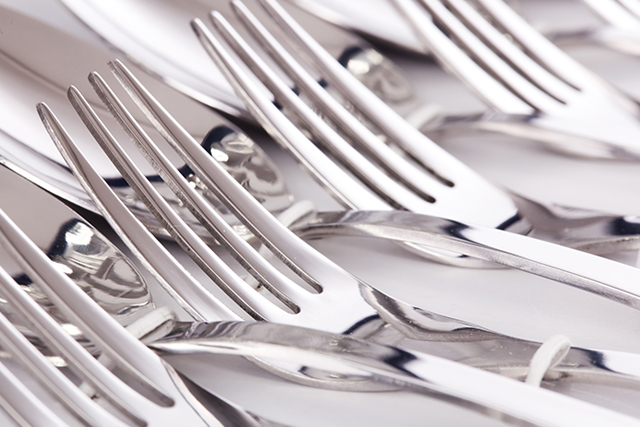
It’s usually in a felt-lined wooden box on a closet shelf, and nobody’s eaten off it since the nineties. At some point somebody asks whether it’s worth anything.
Sometimes it’s worth a few hundred dollars. Occasionally it’s worth several thousand. And sometimes — genuinely — it’s worth almost nothing. The difference comes down to one thing most people can check in about a minute.
Sterling or plate?
This is the whole question.
Sterling silver is 92.5% pure silver throughout. Look for STERLING, STER, or 925 stamped on the back of a handle or the underside of a spoon.
Silverplate is a microscopically thin layer of silver bonded to a base metal. The markings usually include EP, EPNS, A1, triple plate, or quadruple plate. Names like Wm. Rogers, Community, and most Oneida lines are typically plate.
Here’s the hard part: silverplate has essentially no melt value. The silver layer is measured in microns. It isn’t that we won’t buy it — there’s simply not enough silver there to recover. If your set is plate, its value is decorative, and you’re better served by an antique dealer than by us.
If it says sterling, keep reading.
Weight is what matters
Sterling is priced primarily on its silver content, so a heavy set is worth substantially more than a light one — even at the same piece count.
A few things affect that more than people expect:
Knives usually don’t count for much. Most sterling knives have hollow handles filled with cement or resin, and the blades are stainless steel. The actual silver content is small.
“Weighted” pieces are mostly not silver. Candlesticks and some serving pieces marked weighted or reinforced are filled with plaster or pitch for stability. The silver is a shell.
Serving pieces are the heavy hitters. Ladles, meat forks, serving spoons, and trays carry real weight in solid silver.
When it’s worth more than melt
Certain sets sell for well above their silver content, and it’s worth knowing before you melt anything down.
Recognized makers. Georg Jensen, Tiffany, and some early American silversmiths carry a strong collector premium.
Complete matched sets in a desirable pattern, especially with the original box, can be worth more intact than melted. Replacement dealers pay for individual pieces to complete other people’s sets.
Coin silver. Older American pieces marked COIN or 900 predate the sterling standard and can have historical value beyond the metal.
We check for all of this before quoting. It would be easier to weigh everything and offer melt, but if a set is worth more as a set, you should know that.
What to bring
Bring the whole box, knives included, and don’t polish anything first. Polishing removes a small amount of silver and can damage the patina on collectible pieces — it doesn’t help your offer.
We’ll sort sterling from plate, weigh it in front of you, check for maker’s marks, and explain what we’re seeing as we go. Testing is free whether or not you sell.
Alliance Gold & Silver is on Western Center Blvd in Fort Worth. Bring the box in and let’s find out what’s in it.