
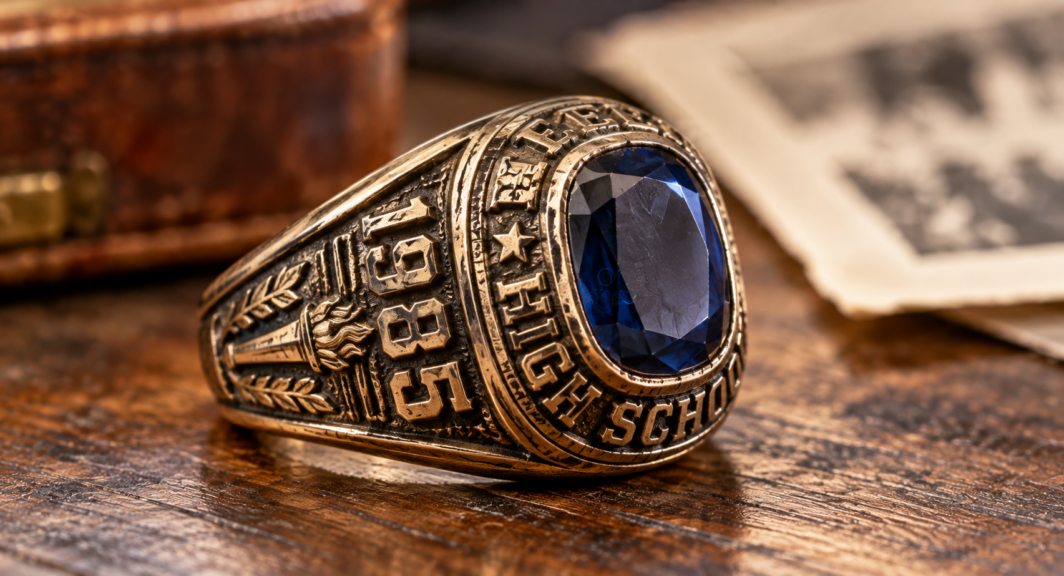
Your high school or college class ring has probably spent years in a drawer. If it’s gold, it could be worth hundreds of dollars today. But not every class ring is gold, and many people are surprised to learn which kind they have.
Here’s how to find out what your class ring is made of and what it’s worth.
Step 1: Find the stamp
Look inside the band. Most class rings carry two small markings: the maker’s name (such as Jostens, Balfour, ArtCarved or Herff Jones) and the metal. You may need a magnifying glass or your phone’s camera zoom.
| Stamp | What it means | Gold content |
|---|---|---|
| 10K or 417 | 10-karat gold | 41.7% gold |
| 14K or 585 | 14-karat gold | 58.5% gold |
| 18K or 750 | 18-karat gold (rare in class rings) | 75% gold |
| Siladium, Celestrium, Lazon | Non-precious alloys, similar to jeweler’s stainless steel | None |
| Golden Siladium, Yellow Lazon | Gold-toned or gold-plated alloys | None, or only a thin plating |
| Silver Select, SilverXT | Silver-based alloys | Contain silver, not gold |
If you see 10K or 14K, you have a gold ring. If you see one of the alloy names, the ring has little or no metal value, even if it looks gold. For more on markings, see our guide to what the stamps on your gold and silver mean.
Step 2: What about the stone?
Most class ring stones are synthetic birthstones or colored glass. They look nice but usually add little to the resale value. Nearly all of a gold class ring’s value is in the gold. If your ring has diamonds, bring it in and we’ll evaluate them separately.
Step 3: Estimate the gold value
A gold ring’s value depends on three things: its weight, its karat, and today’s gold price. Class rings are often heavier than everyday jewelry, which is why they can be worth more than people expect.
Here’s an example, using an illustrative gold price of $4,000 per troy ounce (about $128.60 per gram):
- A 10K ring weighing 15 grams contains about 6.26 grams of pure gold.
- 6.26 grams × $128.60 = about $805 in gold value.
- The same weight in 14K would hold about $1,129 in gold.
Gold prices change every day, and any buyer pays somewhat below the full gold value. The point is that a solid gold class ring is often worth a meaningful amount. Our guide to fair cash-for-gold prices explains how an honest offer is calculated.
Keep it, pass it on, or sell it?
A class ring carries memories, so there’s no wrong answer. Some people keep theirs, some pass it to a child or grandchild, and some decide the cash is more useful today. A few things to consider:
- Engraving doesn’t lower the gold value. Names, years and school crests don’t affect what the gold is worth.
- Broken or bent is fine. A cracked band or missing stone doesn’t change the value of the gold.
- Check the drawer for more. Old class rings often sit next to other gold, like single earrings, broken chains or inherited jewelry. Bring it all in for one evaluation.
Selling a class ring in Fort Worth
At Alliance Gold and Silver Exchange, there’s no appointment needed. We test and weigh your ring in front of you, explain what it’s made of, and make a cash offer based on that day’s gold price. If it turns out not to be gold, we’ll tell you that too. There’s never an obligation to sell.
Bring a valid photo ID, which Texas law requires for precious metal purchases. We’re at 2901 Western Center Blvd #120, just off I-35W, open Monday to Friday 10 a.m. to 6 p.m. and Saturday 10 a.m. to 2 p.m. Call 682-316-4221 or see how it works.