
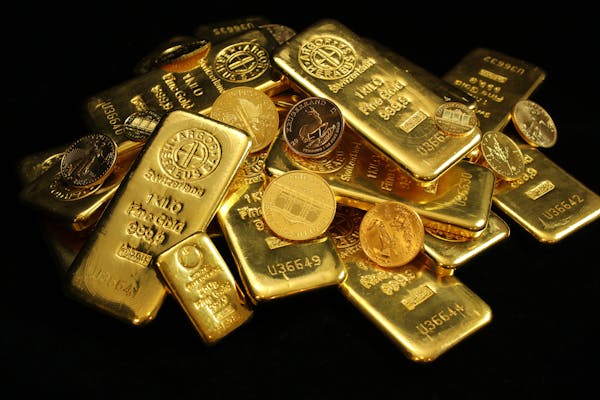
A gold coin has two possible values, and they can be very far apart.
The first is melt value — what the gold in it is worth as metal. The second is numismatic value, what a collector will pay for that specific coin because of its date, mintmark, condition, or rarity. For most bullion coins these are nearly the same number. For some older coins, the collector value is several times the melt value.
Selling a collectible coin as scrap is the one mistake in this business you can’t undo. Once it’s melted, the date and the mintmark are gone. So before you sell anything, it’s worth knowing which kind of coin you have.
First: Do Not Clean Your Coins
If you take one thing from this page, take this.
Cleaning a coin — polish, baking soda, a cloth, an eraser, anything — leaves microscopic scratches that graders can spot instantly. A cleaned coin is worth a fraction of the same coin left alone, and the damage is permanent. Toning and surface grime are not problems. They’re expected on a coin that’s a century old.
The same goes for coins already sealed in plastic holders from PCGS or NGC. Don’t break them out. That plastic is a graded, guaranteed assessment, and it’s worth money.
Bullion Coins: Priced Near Melt
Modern bullion coins are bought and sold as metal, with a small premium. There’s usually no meaningful collector value unless you have a rare year or a proof or special-issue version.
| Coin | Gold content |
|---|---|
| American Gold Eagle (1 oz) | 1.000 troy oz |
| Canadian Maple Leaf (1 oz) | 1.000 troy oz |
| South African Krugerrand (1 oz) | 1.000 troy oz |
| Mexican 50 Peso | 1.2057 troy oz |
| British Sovereign | 0.2354 troy oz |
One thing that confuses people: an American Gold Eagle contains a full troy ounce of gold but weighs more than a troy ounce, because it’s alloyed with copper and silver for durability. The gold content is what matters.
These typically pay closer to spot than jewelry does, because they don’t have to be refined. For how spot converts into an offer, see how to identify fair cash for gold prices near you.
Pre-1933 U.S. Gold: Where It Gets Interesting
U.S. gold coins struck for circulation before 1933 are a different situation. Every one of them has melt value, and many have collector value on top of it.
| Coin | Gold content |
|---|---|
| $20 Double Eagle (Liberty or Saint-Gaudens) | 0.9675 troy oz |
| $10 Eagle | 0.4838 troy oz |
| $5 Half Eagle | 0.2419 troy oz |
| $2.50 Quarter Eagle | 0.1209 troy oz |
A worn, common-date Double Eagle trades at a modest premium over its gold. The same coin in uncirculated condition, or from a scarce year or mint, can be worth many times that. The difference is invisible to most people holding one — which is exactly why these shouldn’t be sold by weight without someone checking.
What Pushes a Coin Above Melt
Date and mintmark. A tiny letter under or beside the design — S for San Francisco, D for Denver, CC for Carson City, O for New Orleans — indicates where the coin was struck. Some mints produced very few coins in certain years. Carson City gold in particular carries a strong premium.
Condition. Coins are graded on a 1-to-70 scale. The gap between a coin that’s been in a pocket and one that never circulated can be enormous.
Certification. Coins graded and sealed by PCGS or NGC sell for more than raw coins, because the grade is independently guaranteed.
Original packaging. Mint sets, proof sets, and commemorative issues with their original boxes and certificates are worth more complete.
Errors and varieties. Doubled dies, off-center strikes, and known die varieties can carry large premiums.
Selling an Inherited Coin Collection
Inherited collections are where the most value gets lost, usually through good intentions.
Leave everything where it is. Don’t remove coins from albums, folders, flips, or slabs. Don’t consolidate them into a bag.
Don’t clean anything, no matter how tarnished.
Bring the whole collection, including the silver, the foreign coins, and the loose change. Sorting is free and the odd items are sometimes the valuable ones.
Bring any paperwork. Old invoices, appraisals, and inventory lists help establish what’s there and occasionally reveal a purchase the family never knew about.
If you’re working through an estate more broadly, what to do with inherited gold, silver, or jewelry covers the wider picture.
Why the Buyer Matters More With Coins Than With Jewelry
With scrap jewelry, any honest buyer using accurate scales and current spot will land in roughly the same place. Coins are different. A buyer who only weighs metal will offer you melt on a coin worth three times that, and the offer won’t look wrong — it’ll look like a fair price for gold. It is. It’s just the wrong question.
What to look for:
- Someone who evaluates coins as coins, not just by weight
- Membership in a numismatic organization — we’re a member of the Texas Numismatic Association
- Willingness to tell you when a coin should be graded before selling
- A breakdown that shows which coins were priced at melt and which weren’t
An honest coin buyer will sometimes tell you not to sell something yet. That’s a good sign, not a lost sale.
Also Worth Bringing
Gold isn’t the only thing in most collections. U.S. dimes, quarters, and half dollars dated 1964 or earlier are 90% silver and worth many times face value. Half dollars from 1965 to 1970 are 40% silver. Silver dollars — Morgans and Peace dollars — often carry collector value well above their silver content, particularly in better condition or from scarcer mints.
If there’s a coffee can of old change somewhere in the house, bring it.
Have Your Coins Evaluated in Fort Worth
We’re a coin dealer as well as a precious metals buyer, and we look at coins as coins first. Everything is evaluated in front of you, and we’ll tell you which pieces are worth more than their gold and which aren’t. Free, no appointment, no obligation.
Alliance Gold & Silver Exchange
2901 Western Center Blvd. #120 Fort Worth, TX 76131
682-316-4221
Monday–Friday 10AM–6PM | Saturday 10AM–2PM
Serving Fort Worth, Saginaw, Blue Mound, Haslet, Keller, and the greater DFW area.